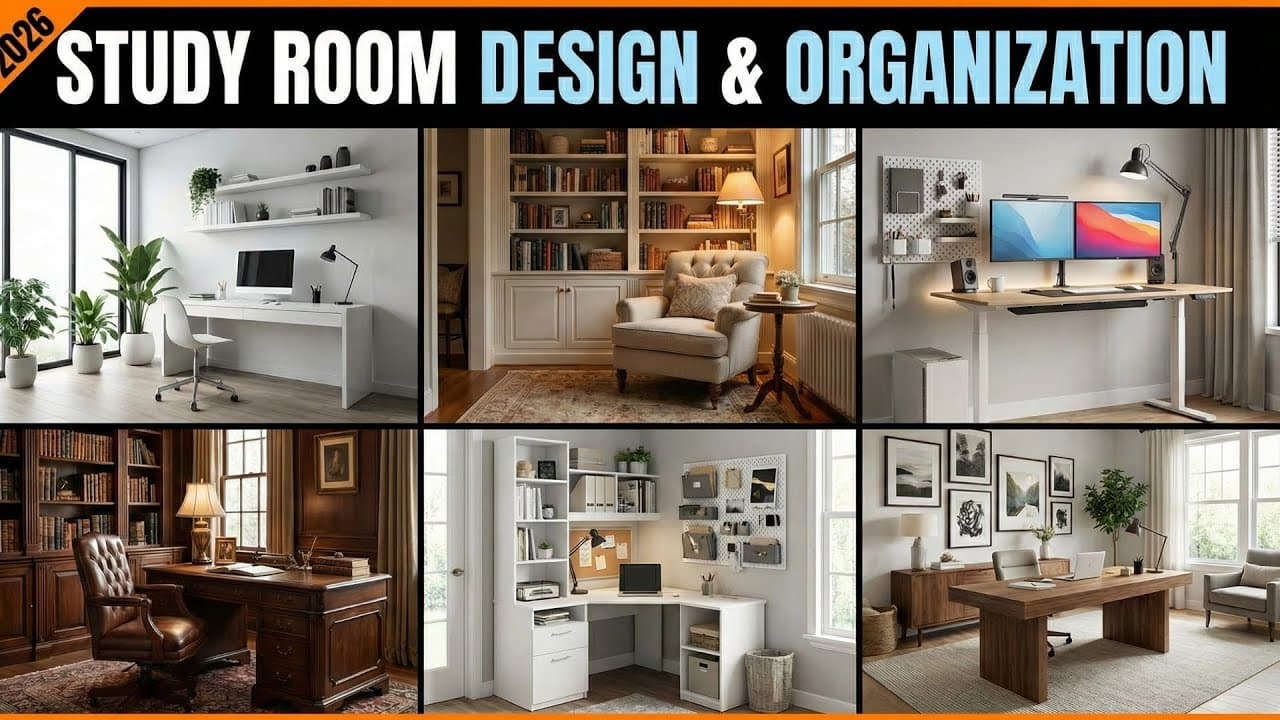
Your current study corner is probably a chair pulled up to whatever flat surface was available, a tangle of charging cables, and a stack of books acting as a monitor stand. It works, barely, but it is not doing your focus any favors.
The right study room design ideas close the gap between surviving your workday and actually thriving in it. Whether you are carving out a closet nook or redesigning a dedicated room, intentional layout choices change everything.
Key Takeaways
- Positioning your desk perpendicular to a window reduces glare while still delivering natural light across your workspace
- A floating desk mounted at 28 to 30 inches frees up floor space and makes small rooms feel significantly larger
- Zoning with a single area rug under your chair visually separates the study from the rest of a shared room
- Vertical shelving above the desk doubles storage without consuming any additional square footage
- Choosing a chair with lumbar support rated for 6-plus hours prevents the mid-afternoon slump that tanks productivity
Full Video Transcript
Want to create a space that sparks focus and deep work? A well-designed study room does more than look good. It supports clarity, creativity, [music] and calm. Whether big or small, here are 12 design ideas to turn your study space into a [music] productivity haven. Before we dive into today's video, [music] I'd like to welcome you to Decoredia, your go-to source for home decor inspiration. [music] We bring you creative ideas to transform your space with style and
ease, helping you [music] elevate every corner of your home effortlessly. If you're new here, don't forget to hit that subscribe button and turn on the bell icon so you never miss out on our latest decor inspirations. [music] Now, let's get started. What type of desk [music] works best? Go for a desk that fits your workflow. A simple writing desk works for laptops or journaling. Need more storage? Try one with drawers or shelves. Corner desks save space.
Choose a clean surface to avoid clutter and keep your focus locked in. Found this helpful? Share it with a friend. Seeking Kong. What's the best way to organize supplies? Use drawer trays, [music] desktop organizers, or floating shelves. Keep pens, paper, chargers, and notebooks within reach, but [music] hidden when not needed. A clean, functional surface minimizes distraction and boosts momentum. Planning a floor update? Save this idea now. Happy. What's the best location for a study room? Pick
a spot with minimal noise. Spare bedroom, attic corner, [music] or even a partitioned section of your living room. Natural light boosts alertness, [music] but good artificial lighting can work, too. Choose a place where you can focus without [music] constant interruptions, like clear, calm spaces. Hit that like button. What's a calming color scheme for study rooms? Go for [music] muted natural tones like sage green, soft beige, dusty blue, or ivory. These shades reduce tension and help keep
the mind clear. Accent with wood, black, or brass for [music] a timeless feel that still feels focused and fresh. Know someone in a small space? Share this tip. What kind [music] of chair supports long hours? Choose a chair with lumbar support and adjustable height. Padded seating [music] helps, but make sure it keeps you upright. Ergonomics matters. Comfort sustains focus and posture affects energy and productivity throughout your session. Inspired to simplify? Tap like and [music] save this
tip. What about sound and noise control? Use soft rugs, thick curtains, or acoustic panels. Noise cancelling headphones [music] or a white noise machine help, too. A quiet space keeps your brain centered. Noise interruptions [music] delay focus and break momentum fast. Thinking about walls? Save this idea. Oh yeah. Should I use wall space for more than decor? Absolutely. [music] Add a pin board, calendar, or whiteboard, hang shelves for books, or [music] tools you use often. Visual cues
help track goals and free your desk space. Vertical planning tools help you stay efficient without the chaos. Enjoy this tip. [music] Give it a thumbs up. How should I position the desk? Place the desk [music] near a window if possible to enjoy natural light. Face a blank wall or minimalist [music] art to limit distractions. Keep cords tidy and items within reach. Good layout reduces mental friction and keeps your energy directed. Love these soothing tones? Give this
video a like. Happy birthday. How do I stay consistent using the space? Keep the room clean and only for study. Don't bring meals or distractions. Leave your tools visible [music] but tidy. Having a study only space cues your brain to focus quickly. Consistency [music] transforms rooms into routines. Feel inspired? Tap like before you go. How do I handle lighting for evening use? Layer it. Use a desk lamp [music] for task lighting and overhead lights for ambiance.
Warm white tones reduce eye strain. Avoid harsh fluorescents. Position lights to avoid shadows across your desk. [music] Good lighting equals longer, more focused work. Like the natural light look? Hit like to see more. How can I add inspiration without clutter? Use framed quotes, small plants, [music] or a calming print. Limit items to two, three personal touches. A vision board works, too, as [music] long as it's focused. Inspiration should energize, not distract from what matters, like mixed
looks. Hit like for more style tips. Can I combine study and relaxation zones? Yes. Add a reading chair or meditation cushion if space allows. Keep this area [music] separate from your desk with a rug or light fixture. Transitioning between focus and rest [music] is easier when the space reflects that shift. Love subtle textures? [music] Tap like to continue. A study room isn't just about furniture. [music] It's about how space supports thinking. With the right design, even
a corner becomes a sanctuary for deep work. Craft it with [music] care, and you'll show up with purpose every time.